1. Current approaches to Digital Humanities. Researches of the EADH Small Grants 2020 recipients
The current panel brings together presentations of the projects which were declared winners of the EADH Small Grants Scheme 2020. Thus, the papers are not necessarily unitary in regards to their content, but are representative for modern-day main trends in digital humanities and for future research directions. The panel’s value rests in its methodological and scientific variety and in showcasing the work of a couple of young researchers.
The presentations go from the very practical, community-oriented, to academic endeavours building-up for future larger research. Thus, the panel is opened by the most hands-on project, delivered by E. Öhman and showcasing an online humanities-focused Python course as an interactive Notebook. The next presentation, belonging to A. Pázsint, applies social network analyses methodologies and tools on sources regarding ancient populations. G. Saygi maps the urban life of premodern-era Amsterdam, while K. Simpson presents a complex visualization of Annie R. Taylor’s trips to Tibet. The following two projects are focused on various aspects pertaining to the materiality of cultural life from Soviet interwar Russia. While one (O. Maistat’s) is an overview of movie and movie-going culture, the other (I. Uchitel’s) works on linguistics, dealing with digitizing and analysing Yiddish press.
The thematic of the selected papers is very diverse, but all presented projects are characterized by solid methodology, original research scheme and desire to give back to the community through open access resources.
1.1. Coding for Digital Humanities: Interactive Notebook with Scaffolded Progression (Emily Öhman)
With the increased visibility of Digital Humanities in academia, there has been a rise in students looking to learn programming, but adoption rates of technology and computational skills in humanities scholars are in practice still low (Abrahams 2010; Hew / Cheung 2014; Croxall / Warnick 2016; Lyon / Magana 2020). Course availability and quality at humanities programmes vary greatly between institutions. Many free online resources that teach programming exist already, but almost all of them are based on traditional computer science approaches and are therefore math- and algorithm-focused rather than text-focused (e.g. Codecademy). The focus on numerical algorithms often leads to humanities students losing motivation as they do not see a connection to their own interests (Forte et al. 2005; Ramsay 2012; Kokensberger et al. 2018; Öhman 2019).
To amend this I am creating an online humanities-focused Python course as an interactive Notebook. The course enables humanities students to learn Python code specific to their needs.
What sets my project apart from other similar projects are, among other things:
- Fully online, free, and interactive. No installations.
- Natural progression into more advanced humanities-focused programming skills, allowing students to seamlessly transform from beginner to intermediate to advanced.
- Linking to existing resources, further empowering students with knowledge and skills to both broaden and deepen their coding skills.
This Notebook will serve as a scaffolding (Vygotsky 1978; Van de Pol et al. 2010) in the student’s learning goals with the provided hands-on assignments created with the Zone of Proximal Development (Vygotsky 1978; Wass et al. 2014) in mind in order to keep the students motivated and maximizing learning potential. Notebooks have been shown to be excellent tools for teaching programming concepts by using scaffolding techniques (Chakravorty et al. 2019). The links to related existing projects will serve as an in-depth explanation of topics supported by this scaffolding, both deepening and broadening the student’s skillset, as well as allowing the student to explore specific topics of interest.
As Digital Humanities scholars, it is absolutely crucial to be able to interpret computational aspects of projects (Koch 1991; Ramsay 2012; Gniady / Wernert 2017; Tracy / Hoeim 2017; Bartlett et al. 2018) and as Digital Humanities students, it is important to future-proof oneself by learning these skills, whether for the general job market or an academic career. The goal of this project is to enable everyone with an interest in computational humanities and computational methods for digital humanities to have access to a comprehensive, interactive guide to learn Python programming specifically geared towards humanities-related tasks with increasingly advanced topics up to an advanced level of programming. The project can also be used by those who teach Digital Humanities-related courses, but are not confident in their own programming skills or simply do not have time to create their own Notebook-like resources. Furthermore, this project promotes existing coding for DH resources, maximizing their potential as well.
1.2. Romans 1 by 1. Augusta Traiana et territorium (Annamária-Izabella Pázsint)
The present proposal “Romans 1 by 1. Augusta Traiana et territorium” has as goal to provide an overview of a research project with the same name, which will be carried out during 2021. The project received a funding on behalf of the EADH for promoting the use of computational methods in the research and teaching of ancient history. The intention behind this scientific initiative is to cover research time for an ongoing project (Romans 1 by 1), with the goals of (1) expanding the open-access database through the ingestion of the epigraphical data corresponding to Augusta Traiana and its territory (up to the 3rd century AD), (2) publishing an overview of the data and of (3) organising a workshop for students to familiarize them with digital methods of studying and researching the ancient world.
The presentation which I hereby propose will focus on summarising the project’s deliverables, more precisely on the quantitative and qualitative data on the population of Augusta Traiana and its territory (up to the 3rd century AD), after previously contextualising the historiographical background against which the project emerged and its methodological pillars.
Fom a historiographical perspective, prosopographical and population studies on Augusta Traiana and its territory have been written at a smaller scale, regarding for example specific individuals (Nikolov 1990; Camia 2013) or onomastic specificities (Dana 2013; Dana 2014; Dana 2016). In this context, the study of the population of Augusta Traiana has left room for more research, our intention being to provide a comprehensive outlook on it with the help of new methodologies.
From a methodological point of view, the proposed project implies the using of both the traditional (epigraphic investigation, prosopographical reconstructions) and the newest research methodologies (implying the use of the Romans 1 by 1 database, software such as Gephi for network analyses). By including these innovative tools for the management, analysis and visualisation of the data which come from inscriptions, traditional prosopographical approaches will be enhanced by identifying specific patters or characteristics in social networks. In what concerns the new methodologies, we imply here the use of a database and of Social Network Analyses, which in this type of research have proven to be effective. As such, the intention is to use the Romans 1 by 1 database – which was created for filling in an existing gap in the study of Roman-era population. The database tries to begin answering the need of properly cataloguing, in an open-access manner, all attested inhabitants of the Roman Empire, following the principles of a population database (Mandemakers / Dillon 2004), not a sources aggregator.
Next, by applying SNA to Augusta Traiana’s dataset we intend to make the most of the prosopographical information, connecting the population beyond their nuclear family.
The project itself will be based on two components: the first one will focus on the results related to the first objective, respectively the creation of an updated and complete repository of epigraphical sources on Augusta Traiana and its territory. The second component is related to the second objective, more precisely the dissemination of the information and education.
Overall, through these objectives the aim of this presentation will be to accurately reflect the outcomes of the implemented project and its pertinence in the current scientific context.
1.3. Examination of space-use in premodern Amsterdam: A digital mapping of individuals’ footprints, everyday life, and mobility (Gamze Saygi)
Historical maps are essential for studying the past. In Amsterdam, many historical map tiles dating from 1625 to 1985 have been made available through the Amsterdam Time Machine (n.d.); these provide information on how governance and interventions, both planned and unplanned, have shaped the urban pattern. In particular, the comparison of historical maps from different periods exposes the changes in the historic street networks, urban expansion, and neighbourhood features. Nonetheless, these maps cannot give us a full account of the historic urban life. In attempting to achieve this, the digital opening of the archives and the visualization of the information coming from the resources they provide, combined with data from the historical maps, play a crucial role. A recently digitized primary source, the merchant registers (Koopmansboekjes), which are available as digital scans at the Amsterdam City Archives, assist with the process. Each merchant register is a book consisting of an alphabetical list of individuals’ names, followed by an indication of which goods they were negotiating and trading with, and their addresses. This bookkeeping practice, which began in 1766 and was carried out annually for half a century, was intended to be as inclusive as possible to ensure that it would be profitable for both the publisher and the merchants. These are proving to be valuable primary sources, especially in the field of economic history; however, their potential to be useful at the interface between commercial life and everyday activities in urban spaces remains unclear. Initial experiments showed that these books held an unexpected added value when examining space-use patterns in premodern Amsterdam in that they depict individuals’ footprints in the city through a coupling based on individual (people) and path (streets) concepts (Saygi 2020). The data derives from the book of 1784 and the textual hints, which indicate of their residential and business locations, are used to determine individuals’ footprints (Stadsarchief Amsterdam n.d.). First, the hints are automatically recognized as text, cleaned, and structured, and are then semi-manually transformed into geolocations and attributed to each individual. This is followed by the automatic geocoding of the routes between business and residential locations and the visualization of the mobility patterns of individuals. Inspired by the results of that experiment, the aim of this paper is to look at multiple select set of books and to develop a space-time mapping approach for deciphering the changes in the governance of Amsterdam’s streets (Figure 1). The paper looks at the concept of mobility to uncover everyday life sequences in premodern times which involves mapping individuals’ footprints in urban space based on their commuting patterns as a prominent daily activity This, in turn, can help us to understand the changes in the spatial use patterns over time by highlighting the variety in distances travelled and variations in the covered area and determining where neighbourhoods are trespassed. As a result, this research will create a spatial turn when studying urban history by visually deciphering the city’s informal governance through mobility patterns at the turn of the nineteenth century.
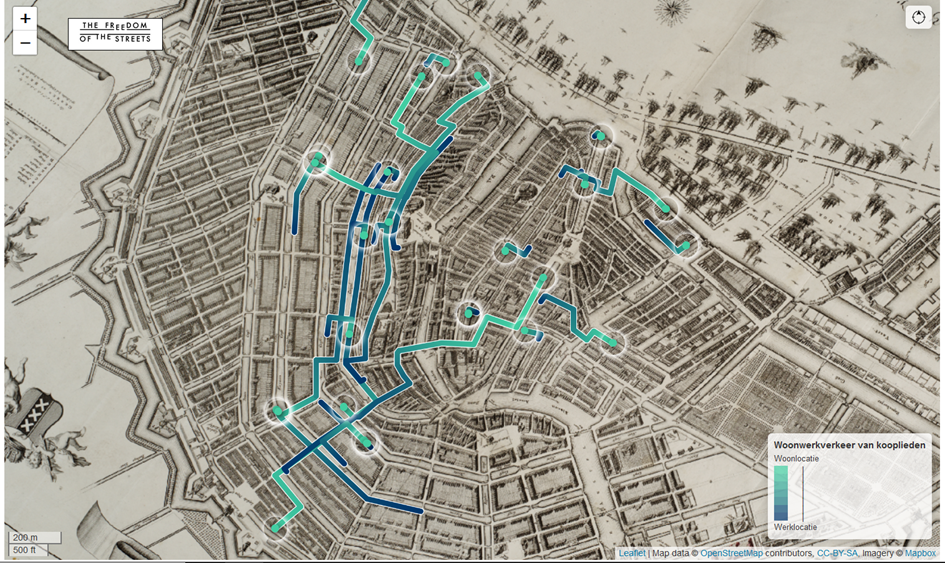
Figure 1: The extraction of the merchant mobilty routes from work (blue) to home (cyan) in 1784 as hypothesis.
1.4. Ruled Margins: Annie R. Taylor’s journeys to Tibet (Kathryn Simpson)
In this paper I discuss the creation of a digitally interactive and searchable map of the missionary Hannah Royle Taylor’s (1855-1922), known as Annie R. Taylor, four journeys to Tibet. The digital map of Taylor’s journeys is embedded with XML encoded text and objects to understand the process of representation and object acquisition as it pertains to the constructed narrative of nineteenth century European exploration.
Between 1887 and 1892 Taylor, who had initially travelled to China as part of the China Inland Mission, made four journeys along the borders of and into Tibet. Of particular note was the journey made between September 1892 and April 1893, when Taylor attempted to reach Lhasa the capital of Tibet, accompanied by one Tibetan, Puntso and three Chinese assistants. It was a difficult and dangerous journey, but as with a lot of European missionary narratives Taylor believed her Christian god would protect her, “He has sent me on this journey, and I am his little woman. He will protect me.” (Taylor 1902: 135). Taylor heavily publicised her journeys when she returned to Britain, as well as two published narratives of these journeys, she presented a paper at the Scottish Geographical Society, made numerous public speeches and sold two lots of Tibetan objects to the then Edinburgh Museum of Science and Art, now the National Museum of Scotland (NMS). Taylor’s interpretation of Tibet and its cultures and people would feed into European understandings of Tibet, a ‘constructed’ missionary interpretation, which situated Tibet as ‘other’ and ‘exotic’.
Using Taylor as an example, I explore new ways of engaging with and representing the site of intercultural encounter. I will also evidence Taylor’s influence on Scottish representation and understanding of Tibet. Thirdly, I will show how digital tools can be used to bring out the muted historical narratives of the indigenous Tibetan and Chinese individuals that assisted Taylor on her journeys. Digital humanities tools have facilitated extensive and often ground-breaking developments in understanding the role of male European missionaries and explorers in the nineteenth century. Importantly, they have showcased the influence of these travellers in constructing representations of people and place. Whilst the range and depth of digital study of male European travellers has been extensive, there has been little comparative digital exploration of female European traveller narratives or of indigenous local peoples who supported and worked with such expeditions. As it has been primary to this project to use digital tools to encourage disruptive and counter-consensus readings of history, I will end this paper by reflecting on the successes or failures of these tools in facilitating this type of research practice.
1.5. Mapping early Soviet Film Exhibition, 1921-1934 (Oksana Maistat)
This paper deals with a project about the film distribution and exhibition during the first decade of Soviet regime. The data on film exhibition allows for several approaches and has interdisciplinary potential, as it might be treated from the perspectives of economic history, film or social history, and it speaks for the forms of leisure activities, as well as the history of cityscapes and film distribution networks. Most importantly, the database on the history of the Soviet film distribution should become an invaluable tool for research into film culture during the NEP period, which would enable a reasoned analysis of cinema as a form of leisure and produce a differentiated picture of cinema history and, in a wider perspective, for research into the formation of mass culture in the USSR during the first decade of Soviet power.
1.5.1. Presentation key points
- project scope and methods
- approaches to analyze and interpret the data
- patterns of film exhibition: first vs. second run cinemas, films routes through the theater network, POPSTAT etc.
- possibilities for further utilization of data
1.5.2. Project description
The present project is a work-in-progress database on the history of the film exhibition in Soviet Union during one of the most interesting periods of its history – the New Economic Policy, 1921-1928. During this period Soviet film market was free from state regulation and flooded with foreign film production, which attracted a wide audience after the isolation from the civil war period (Youngblood 1993). Reviving after the war and suffering from a shortage of personnel, raw materials and equipment, Soviet cinema could hardly compete with outdated and therefore cheap imported films. In 1928, the New Economic Policy was curtailed and the transition to a planned economy began, which manifested itself in a gradual cessation of imports. Nevertheless, as our preparatory studies show, some foreign films were screened until the mid-30s, much longer than official resolutions prescribed (Ol’khovyi 1929).
However, this picturing is based on memoirs and impressions of eyewitnesses because there was no control over the film market, as well as no centralized statistics or box-offices until 1944 (Turovskaya 2010). The goal of our project is to remedy this lack of statistics with extensive data on film exhibition, collected from contemporary newspapers and film magazines. This will allow raising questions about the coverage of the cinema network and the availability of film screenings, the diversity of choices for the viewer in specific communities, as well as the indicators of demand for films and cinemas based on POPSTAT method (Sedgwick 2000).
This methodology of studying film exhibition and movie-going practices was elaborated as a subfield of the wider school of “new cinema history”, which approaches cinema as a complex phenomenon, not so much as an art form but rather as a social and cultural practice: going to movie theaters, organizing film circulation, shaping the repertoire and divertissement etc.(Maltby et al. 2011). The research topic thus lies at the intersection of several historiographical fields: history, anthropology, art history and economic history.
Our thesis is that the cinema of the NEP period was an extremely specific phenomenon of urban daily life: in conditions of relative economic independence of cinemas, which were self-sufficient, the viewer was the actor who could independently choose what to watch and even influence the shaping of the program. The 1920s was thus a unique time when the state, entrepreneurs and the audience themselves had comparable weight in the organization of film distribution and leisure activities. The viewer’s subjectivity becomes much less important already in the next decade when the cinema becomes centralized and hence more dependent on the state and party politics.
1.5.3. Methodology and goals
The basis of the relational database consists of three most important entities, which include: 1) film metadata (title - soviet and the original, directors name, year of production, country of production, IMDB-ID, that will allow for future data scraping and compatibility with other national datasets, etc.), 2) movie theaters (name, city name, dates of operation, geographic coordinates), and 3) a table with programs connecting the film, theater, date of the screenings and the data source. These three main tables will be supplemented, as necessary, by tables with information about individuals (directors, cameramen, actors, screenwriters, tenants, and employees of cinemas), studios, addresses and sources.
At the first stage, we plan to collect data on the largest Soviet cities: Leningrad and Moscow, and to expand it in the future, starting with the largest cities, capitals of national republics, and conducting comparative case-studies.
Ultimately, this database should become an open tool for analyzing not only the distribution and life of films that could travel around the country for many years, but also the film audience and infrastructures, exploring the history of what we want to call “film cultures” in contrast to the film history and film studies, which for many years focused on aesthetic issues, leaving aside questions related to the circulation of films in society. In addition to the possibility of revising the notion of urban film culture, data collection can encourage collaborative work and bring researchers from different countries and cities together to create a network like that already existing, such as CinemaContext.nl or ItalianCinemaAudiences.org. In contrast to earlier attempts to systemize information on film distribution, our advantage will be the openness of the database for additions and further reuse.
1.6. Soviet Yiddish press digitization start-up project (Ilia Uchitel)
In this presentation, we are going to describe the project of digitalization of Yiddish newspapers published in the Soviet Union in the period spanning from 1917 century to the beginning of WW2.
The subject of separate development of Yiddish written language in the Soviet Union has been studied, and its features, such as phonetic transcription of Hebraisms, are quite known and were described in such works as “Soviet Yiddish” by Gennady Estraikh (1999). However, the rich varieties of the pre-war Yiddish language in the territories of Soviet Union still have a lot of under described features. One of the approaches to tackle this problem are large-scale corpus studies in the paradigm of historical corpus sociolinguistics, such as in Rutten, van der Wal (2014), Simonenko et. al. (2020 or Szmrecsanyi (2017).
It seems that the primary source for corpora studies of Yiddish language in the Soviet Union is the press.
In the pre-WWII Soviet Union numerous Yiddish-language periodicals were published not only in huge cities as Moscow or Kiev, but also in small localities such as the Jewish collective farms of Southern Ukraine. We hypothesize that the latter documents represent greater regional variance of Yiddish language than the edited fiction or non-fiction books printed in several huge Yiddish-language publishing houses. However, it is exactly this kind of documents that has not been yet digitized.
One of the key problems for such studies is the lack of relevant text data in public access. Therefore, the scanning of periodicals is the foremost task for such research.
While there are numerous online databases containing different digitized documents of Yiddish culture, such as Yiddish Book Centre Digital Library or Historical Jewish Press project, when it comes to studying the development of Yiddish language in the pre-war Soviet Union, these services cannot provide a great variety of data (even though Yiddish Book Centre library holds several hundreds of books published in this period in Soviet publishing houses, primarily in Moscow by “Emes”).
However, scanning is not enough for a source designed for a linguistic corpus study. The preparation of data should then include other essential stages.
First, the text in periodicals we intend to study must be optically recognized (OCR) with a low error rate. Secondly, the text in the periodical should be correctly split in separate chunks, according to the articles and other materials (i.e. advertisements), and accordingly tagged. This should allow linguistic analysis accounting for genre/register variation (on the importance of this, see Cvrček et al. 2020). Ideally, each article should also be tagged with name of the author and some basic information about this person (i.e. Date and place of birth), when available. Such tagging was partially implemented in the press section of General Regionally Annotated Corpus of Ukrainian (Shvedova et al. 2017-2020).
However, such analysis requires a huge amount of time, with automatization only partially possible to employ. Thus, the scanned newspapers should be available in two forms: as digital scans of the original pages, with ALTO/Mets polygon tagging, and also as a collection of tagged texts suitable for linguistic research.
The presented project is a pilot study aimed to develop a methodologically and technologically sound pipeline for digitization of Soviet Yiddish Press, which is applied to a limited number of digitized periodicals. The project consists of several stages.
At the first stage, a united digital catalogue of Yiddish press is compiled. For that, the library cards of the main two libraries holding these documents (Russian State Library in Moscow, Vernadsky National Library of Ukraine) are digitally catalogized. The digital catalogues of other two huge libraries holding Yiddish Soviet periodicals (Russian National Library in Saint Petersburg and Ukrainian Book Chamber in Kyiv) are also integrated, as well as available historical bibliographical data about the lost periodicals of early Soviet Period.
This catalogue, published online as a fully-searchable united database of these vast funds (more than 1500 individual titles of various periodicals) will provide a necessary insight into the scope and variety of these materials and allow to select a sample to be digitized first of all, as well as historical outlook on the phenomenon. In the current presentation we will discuss the outcomes of this stage in detail.
At the second stage, a selected sample of documents is digitized. This data, combined with some already digitized materials is then processed according to the common standards (i.e. METS/ALTO tagging), including OCR, and then is uploaded to a specially built web-platform, allowing, among general access, carrying out linguistic and computational studies.