1. Introduction
High-quality morphophonological data is an asset for research and work on transcriptions as well as a basis for text-to-speech generation. Building a database of a basic inventory of phonemic and phonological information opens new ways not just for grapheme-to-phoneme alignment but also for refined searches in language data.
This poster presents a morphophonological lexicon for German derived from the standard lexical resource CELEX (Baayen et al. 1995), which includes derivations of morphological hierarchical structures. Other freely available tools mostly use grapheme-to-phoneme conversion based on contextual information (Kisler et al. 2016; Reichel 2012; Reichel / Kisler 2014), word similarity (Marchand / Damper 2000), or probabilistic approaches (Bisani / Ney 2008; Reichel 2012). 1 Schröder / Trouvain (2003) derive their pronunciation lexicon from CELEX, by using grapheme-to-phoneme conversion as back-off method for unknown words. However, the performance for compounds and other unknown words yields an error rate of over 50% (Burkhardt / Reichel 2016).
Our method combines the refurbished version of the phonological part of CELEX for German (CELEX-G), a lexicon of morphological structures for German derivatives and compounds (Steiner 2019a), and a recursively morphological analyser based on the morphological tool SMOR (Schmid et al. 2004). The scripts are publicly available on github at https://github.com/petrasteiner/morphology.
2. Data situation
CELEX has a long history and can be considered a very solid standard for building morphological resources. The phonological part comprises phonological analyses of German in combination with morphological boundaries. As the resource was developed in the nineties, its encoding and spelling are outdated. Another issue is morphological analysis on a deep level which is oriented towards diachronic description. In analogy to the morphological structures in the respective CELEX-G entries, these are acceptable conversions from a diachronic point of view but are not useful for modern applications. Therefore, phonological and morphological data have to be transferred to a synchronic form of description.
For instance, the immediate constituents of Abschlussprüfung ‘final exam’ are Abschluss ‘conclusion’ and Prüfung ‘exam’ (1). Abschluss is a derivative of the verb schließen ‘to close’. It is a result of ablaut alternation and thus leads to spelling variants of ss vs. ß. This kind of morphological derivation is also mirrored in the morphophonological analyses of the German phonological lemmas as in (2) which shows an extract of the data:
(1) 605\Abschlussprüfung\Abschluss+Prüfung\
((((ab)[V|.V],(schließ)[V])[V])[N], ((prüf)[V],(ung)[N|V.])[N])
(2) 605\14\Abschlussprüfung\’&p-SlUs-pry-fUN\[ap][SlUs][pry:][fUN]\[...] [VC][CCVC][CCVV][CVC]\ap#Sli:s#pry:f+UN
Here, [SlUs] is analyzed as a noun which is formed by a (historical) conversion of the verb stem [Sli:s]. This might be interesting for the study of sound shifts. However, for many applications this representation is inadequate. Therefore, this kind of information had to be changed systematically.
3. Conversion to new standards
The procedure started with changing the orthographic part of the CELEX database to modern standards, by transforming outdated encodings and spelling variants on the basis of the Duden (Dudenredaktion 2013). 10,649 changes within the entries were performed.
Our aim is to reconstruct the surface form from the lemma and the phonemic information. To find differences between these, we checked each entry by transforming its phonetic and its morphophonological information and then comparing the results of the transformations. The transformations include the German Auslautverhärtung (terminal consonant devoicing) as in (3) or an addition of schwa for derived nouns, for instance bürst ‘verb stem of to brush’ and Bürste ‘brush N’ (4). The examples contrast the phonetic and the phonemic representations of the lexemes. No change of the structure is necessary, if both forms are equal or similar according to the transformation rules.
(3) Abendbrot ‘evening meal’ [a:][b@nt][bro:t] vs. a:b@nd#bro:t
(4) bürsten ‘to brush’ / Bürste ‘brush N’ - [bYrst] vs. bYrst@
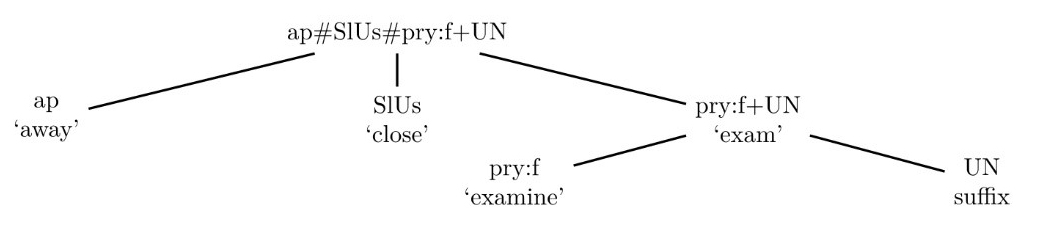
The entries with differing analyses were then changed by substitution rules which were partially built on the foundation of Ablaut series and partially deduced otherwise. The generated morphophonological structure of Abschlussprüfung is presented in Figure 1.
Figure 1: Surface structure for the morphophonological analysis of Abschlussprüfung ‘final exam’
4. Results
We checked the coverage of these forms for the Korpus Magazin Lufthansa Bordbuch (MLD), which is part of the DeReKo-2016-I (Institut für Deutsche Sprache 2016) corpus (Kupietz et al. 2010), an in-flight magazine with articles on traveling, consumption, and aviation. The corpus comprises 38,319 word-form types, of which only 8,621 (22.50%) were covered by CELEX-D. As the newly generated lexicon comprises a basic vocabulary, the coverage of the word-form tokens coverage is almost doubled (41.01%).
The remaining 29,313 lemmas were analyzed by a combination of the morphological tool SMOR (Schmid et al. 2004) and a tool for the disambiguation and derivation of their hierarchical word structures by using morphological databases (Steiner 2019a) and exploiting co-occurrences within a large Wikipedia corpus (Steiner 2019b). This yielded a coverage of 93% correct analyses. The newly gained morphophonological descriptions can be added to the lexicon.
5. Acknowledgements
This article is the outcome of research conducted within the Africa Multiple Cluster of Excellence at the University of Bayreuth, funded by the Deutsche Forschungsgemeinschaft (DFG, German Research Foundation) under Germany’s Excellence Strategy – EXC 2052/1 – 390713894. Many thanks go to Pia Bergmann from the Friedrich-Schiller-Universität Jena who gave me valuable feedback and motivation for this project.