1. Abstract
We describe the construction of a linguistic corpus as a Digital Humanities (DH) project and in the context of Linguistic Landscape (LL) field 1, the documentation of COVID-19 related signage in Israel, mostly regarding the obligation to wear a mask in public places. The uniqueness of this phenomena is the combination of an authorized directive and a spontaneous reaction to a new and unknown situation, a reaction which uncovers the many ways that language enables its speakers to express even a simple directive and the variety of environmental and social aspects that affect it 2.
2. Introduction
On 18/4/2020, the Israeli Ministry of Finance published COVID-19-related commercial regulations as a step towards normalization after the first lockdown. The new regulations 3 approved commercial businesses to be opened on 21/04/2020 if they conformed with several conditions, one of them was that all people must wear a mask in any public area. Businesses were required to prevent anyone without a mask from entering, and were obliged to hang signs at the entrance with these instructions.
In a day, all businesses in Israel were ‘covered’ with signs conforming to these regulations. As the wording of these instructions were not given directly from the authorities, a wide diversity of expressions emerged to convey the simple directive: ‘wear a mask’.
Our project documents this sociological and linguistic phenomenon which goes beyond the streets of Tel Aviv. The collection maintains the context for each sign, and therefore it is not only a collection of photographs or of transcribed texts, but a full body of knowledge including temporal and geographic information for each sign, data which can be further enriched and annotated for research, presentation and preservation, a practice that is well familiar in Digital Humanities research.
3. Background
Linguistic Landscape (LL) is “a field in sociolinguistics which attempts to understand the motives, uses, ideologies, language varieties and contestations of multiple forms of ‘languages’ as they are displayed in public space” (Putz / Mundt 2018); the use of the word languages here may be expanded to all visible semiotic signs in public space (e.g., photos or logos). Research on LL in Israel includes Ben Refael et al. (2006) which inspected the different languages visibility in Jewish, Mixed and Palestinian communities. Waksman and Shohamy (2010) showed how LL writing and designs in Tel-Aviv integrates the city into the national narrative. Shuster et al. (2016) analyzed language accessibility in Israeli Hospitals through signage and show how an absence of clear policies results in a poor language and cultural accessibility to the information in those institutions.
Digital spatial practices in Linguistic Landscaping was previously introduced in works such as Wrisley (2020) who describes the complexities and the methods used for mapping and analyzing the languages of Beirut as a Digital Humanities (DH) project, all based on data created ‘in the field’.
Regarding the Covid-19 pandemia, there were some blog-based publications with various aspects such as by Li Wei and Zhu Hua 4 who analyze the hand written vs. printed signs taped to glass doors in London stores and claim that “the medium of handwriting indexes spontaneity and informality as well as the identity and personality of their writers.” Additional analysis was published on the language of signs in Mexico City 5 and Abu Dahbi 6.
4. Method
Since June 2020, we document signs in a partially systematic way: photographing signs on stores and public places, mainly in Tel-Aviv. Our dataset now contains approximately 2500 photographs from which we extract temporal and geographic metadata, and use geographic services to enrich it with full addresses in order to have explicit information. Transcription is performed manually, and we put it with additional information into a table (so far for 1400 signs).
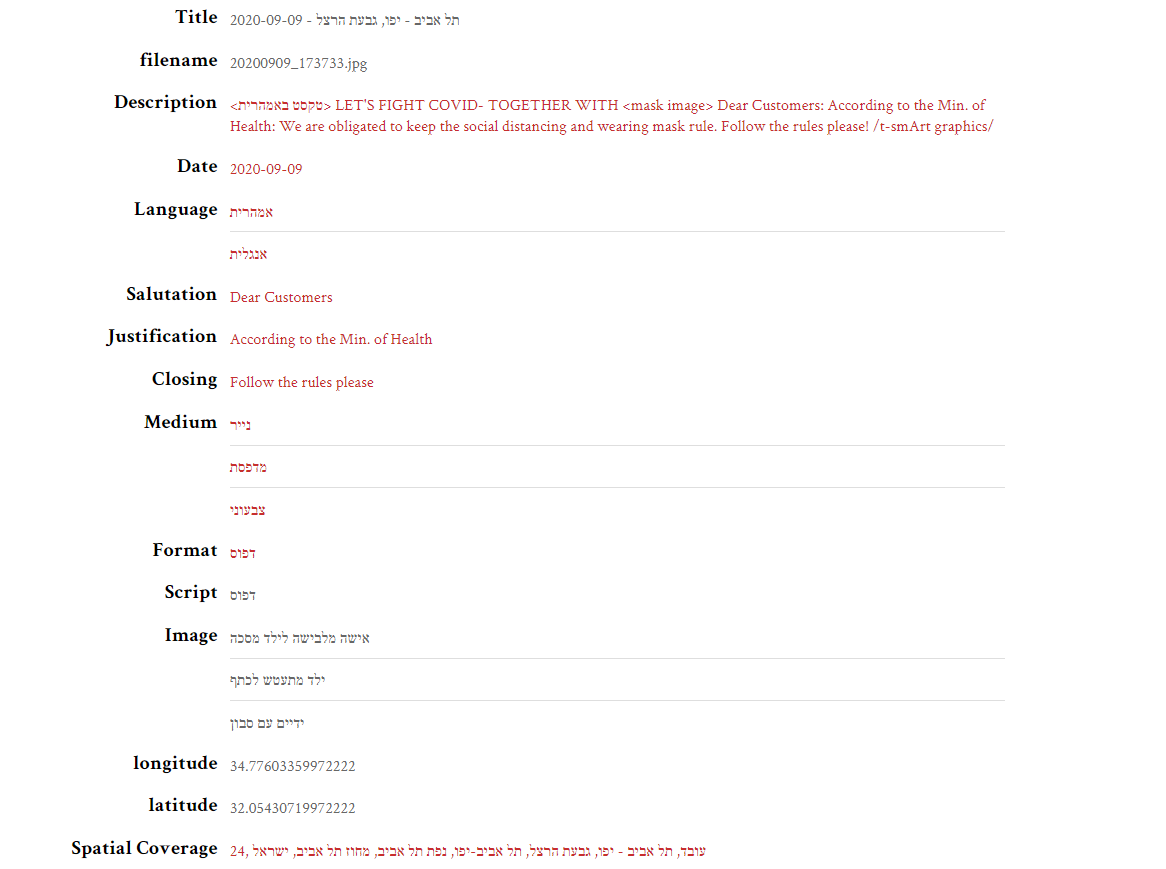
The transcription preserves some attributes of form (so it can be annotated, in the future, with xml standards such as TEI/XML). Metadata of transcribed signs include writing method (printed/handwritten), the script used (block/cursive), the languages on the sign, the material of the sign, the business type (e.g. hairdresser) and a short description of graphical elements and emojies, but also discursive information as the salutation, justification, closing and manners of self-reference.
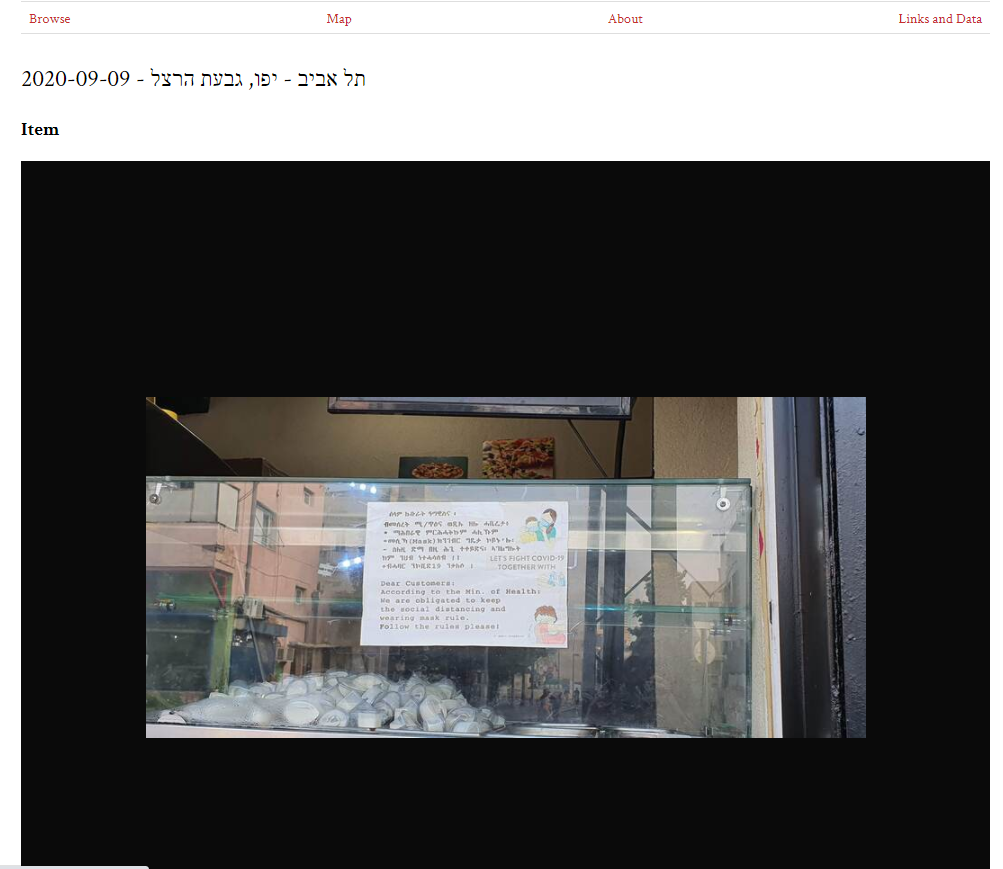
The metadata is uploaded with the photographs to an Omeka-S based site (see Figure 1), where data can be searched and browsed on a map; all data is downloaded.
Figure 1: Omeka-S page of bilingual signs
5. Findings
Two main linguistic aspects are considered: multilingualism and lexical-syntactic variations.
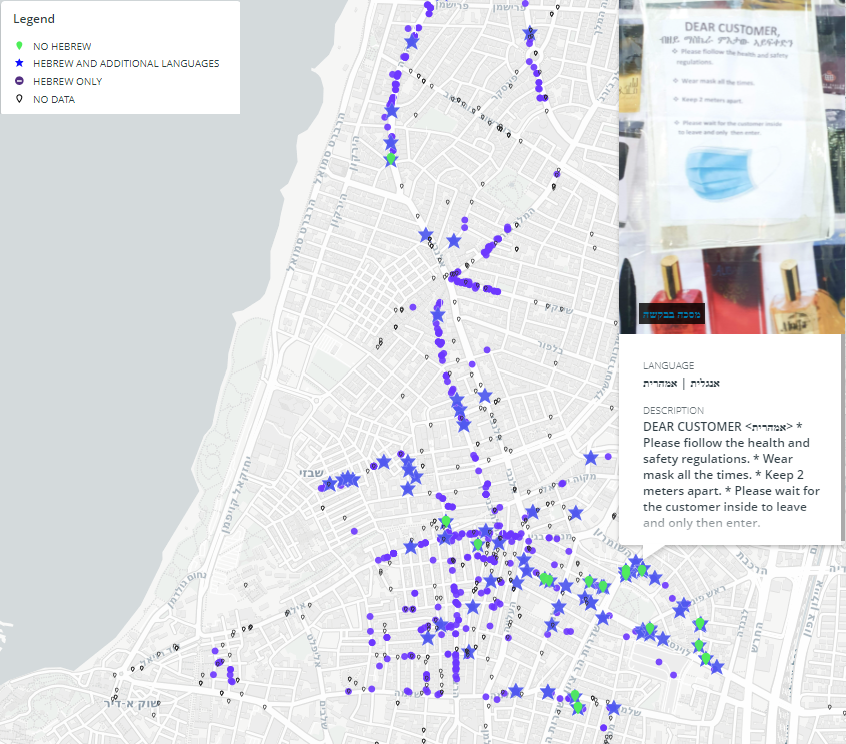
Most non-Hebrew ‘wear a mask’ signage is found in Neve Shaanan, Tel Aviv, a neighborhood with many inhabitants, mostly immigrants from African or East Asian countries, and not in neighborhoods like Newe-Tsedek, which, in non-pandemic times are packed with tourists. Further investigation of the data shows how linguistic style is spreading beween neighboring businesses (see Figure 2).
Figure 2: Multilingualism in ‘wear a mask’ signage in Tel-Aviv – Jaffa
In linguistic terms, variations of language are found at all levels: orthographic, syntactic, morphological, lexical, and pragmatic. We analysed the transcribed signs, using a Part-of-Speech tagger 7. Variations in modality (most frequent are יש and חייב meaning one must, negative אין comes after, then additional modals as אפשר or ניתן/may): in general, 72% of signs’ orientation is positive. The most frequent verb is לחבוש/to-tie, then the more specific and marked לעטות/to-don, followed by the casual, unmarked לשים/put, להצטייד/be-equiped ללבוש/to-wear. Orthographic variations are common to the noun מסכה/mask (810 מסכה, 540 מסיכה). In future work we will present more thorough analysis as to the connection between the varitions to their locations.
6. Conclusions
Covid-19 pandemic created a new situation which entails new regulations and requires language to express them, as well as symbols and graphics that depict them. This is a short window in time. Taped signs don’t hold forever on a door. Ink fades. Regulations change 8. Uncertainty may be replaced with certainty. This project captures this event, documents it, preserves, presents and represents it. It reflects a linguistic landscape of a moment and it enables a unique glimpse into the mechanism of language in a historic event.