1. Introduction
This paper presents the design of the project Terrorism in Swedish Politics (SweTerror) one of Sweden’s largest ongoing digital humanities projects that pioneers a deeply multi-modal mixed-methods approach to the discourse on terrorism in Swedish politics and develops an extensive speech-to-text digital resource for humanities and social sciences (HSS) research.
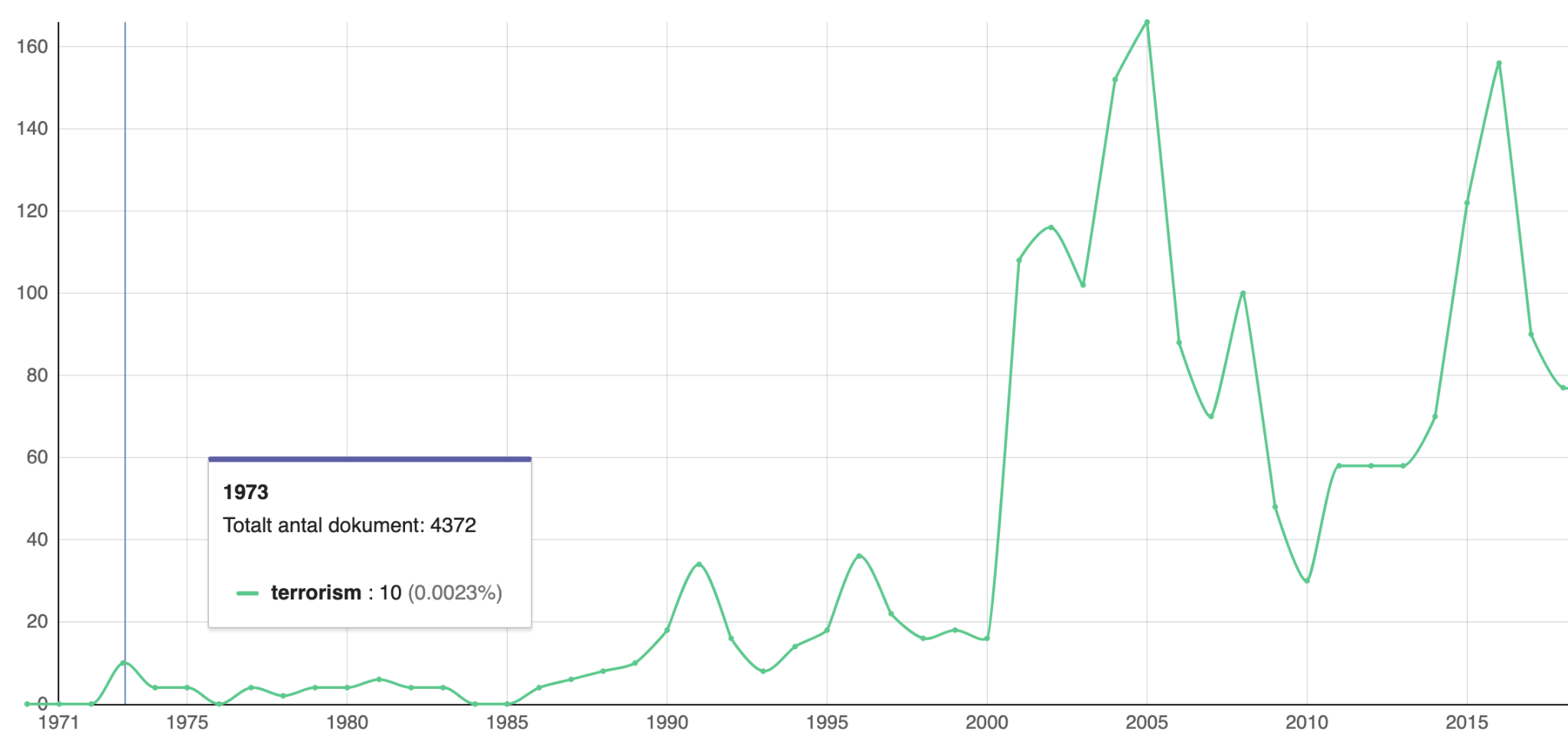
Swedish politics has been transformed by terrorism (Figure 1). The 9/11 attacks accelerated a process that has given terrorism political prominence through several events since the 1970s, including the 1972 Bulltofta skyjacking, the ensuing anti-terrorism legislation; the 1975 West German embassy siege; the “Laser Man“ killings 1991–1992; the internet surveillance “FRA law” in 2008; and the 2017 Stockholm truck attack. Despite this salience, postwar Swedish terrorism has been largely neglected in research.
Figure 1. ‘Terrorism’ occurrences in Swedish parliamentary motions 1971–2018 (riksdagsmotioner.dh.gu.se/#search/terrorism/)
The SweTerror-project was recently granted funding by € 2,2 M for 2021–2024 within the DIGARV (Digitisation and Accessibility to Cultural Heritage Collections) program initiated by the 2016 Swedish Government Research Bill. The parliamentary terrorism discourse is highly suitable for data-driven mixed-methods research and SweTerror explores in detail terrorism’s sustained impact on Swedish politics at large. In Sweden, the Riksdag’s Open Data (ROD) (http://data.riksdagen.se ) maintains not only various digitised documents, but also audiovisual recordings from parliamentary debates since more than 50 years. This source material is underexplored as the current debate transcripts are not word-for-word accurate and omit speech specific characteristics essential to interaction studies and conversation analysis. Search tools are also lacking and the recordings’ content are not readily accessible to scholars. However, rather than the imperfect transcripts, SweTerror, takes as its foundation not but the actual speech in plenum – the physical manifestation of the emerging policy-making – and provides a systematic study of the political discourse on terrorism by also examining all other terrorism-related utterances in the digitized parliamentary and governmental texts from the late 1960s until today. The focus on parliamentary action affords detailed consideration of perceptions, values and agendas enacted in debates, motions, reports, etc. as frames of reference by which political representatives have situated the phenomenon of terrorism.
2. Design and aims
SweTerror has an overarching interdisciplinary methodology that integrates mutually beneficial experiences and research goals: the HSS researchers’ (e.g. historians, political scientists and linguists) questions provides a use case, setting the requirements for the data analysts (e.g. KTH Royal Institute for Technology Division for Speech, Music and Hearing), who collaborate with the data holders (e.g. ROD, the research infrastructure the National Language Bank and Swe-Clarin), who is given increased visibility and usage of the data. Firstly, SweTerror rigorously analyse the textual dimensions of the parliamentary discourse on terrorism and the communicative manner and context in which it has emerged, exploring an issue critical to Swedish scholars and the public alike. Secondly, the project extensively curates and makes readily accessible an understudied multimodal collection of source material of central relevance to Swedish democracy and develops a validated mixed-methods approach for the data-driven study of parliamentary discourse, setting the stage for future research of parliamentary debate data. Thirdly, SweTerror provides a showcase of how multimodal cultural heritage collections, purposefully curated, can form the basis for data-driven investigations and enhance existing HSS methods.
The project investigates a range of aspects of terrorism’s configuration in Swedish politics. By exploring the political language’s semantic aspects (terrorism as a label, metaphor, etc.) and emotive aspects (emotive expressions, tones of voice, etc.) it studies terrorism framing as policy discourse and as enacted politics. SweTerror additionally maps and analyzes social actor networks involved in the parliamentary process. The project answers several research questions: What labelling and discursive frames have been applied to deliberations on terrorism in Swedish politics? What political domains – foreign policy, defense, EU politics, immigration politics, etc. – has terrorism been inscribed in? What actors and network formations have been involved in configuring the discourse? What factors influence actors’ political engagement with terrorism politics, including political affiliation, gender and age? What role does emotional politics – emotional speech and displays – play in parliamentary terrorism discourse? How do terrorism-associated valences of the political language show the domestication and securitization of terrorism?
3. Disciplinary contributions
The project primarily contributes to three rapidly expanding research areas. Firstly, terrorism studies go back to the 1970s, when “terrorism” became the preferred label for a range of acts of political violence (Stampnitzky 2013). Our understanding of terrorism follows the critical terrorism studies (CTS) ‘minimal foundationalist definition’ (Jackson 2011) and follows a major CTS direction that analyzes the social constructedness and labelling of ‘terrorism’ by parliament and media (Brulin 2015). There are few historically elaborated studies on Swedish terrorism and SweTerror will provide a comprehensive understanding of the framing of Swedish terrorism politics, expanding the focus from anti-terrorism policy (c.f. Hansén 2007) to terrorism’s overall impact on Swedish politics. The project will provide systematic analysis of the current Swedish terrorism discourse and long-time outcomes of policy-making under duress, and it will widen international terrorism studies through a pioneering multimodal case study on the political discourse on terrorism.
Secondly, SweTerror situates terrorism within legislative politics, which studies the contextual aspects of policy-making and behaviors of politicians. We draw upon research on politicians’ uses of emotions to promote status quo or policy changes (Glassner 1999) and the gendering of legislation (Bäck et al. 2014). SweTerror will increase the accessibility of the under-utilized multimodal parliamentary debate records as primary source material; pioneer multimodal studies of Swedish parliamentary debate with regard to emotional displays, discursive framing and social networks; and develop data-driven workflows allowing studies of topic-specific parliamentary debate discourse within legislative politics.
Thirdly, SweTerror contributes to digital humanities (DH), particularly to “tools-and-archives" and the concern for knowledge production and dissemination (Liu 2014; Rockwell / Sinclair 2016). Today, data-mediation sites make massive amounts of parliamentary text accessible for queries (e.g. DiLiPaD project) and there are many ongoing European initiatives for compiling collections of parliamentary data, varying from parliament-focused corpora (e.g. EuroParl; the Dutch PoliMedia project; EPIC – European Parliament Interpretation Corpus; UK parliamentary proceedings) to task-oriented collections (e.g. WIP – War in Parliament; LIPARM). This is also one of the current focus areas of CLARIN ERIC. SweTerror goes beyond conventional text-based analysis of parliamentary discourse through the inclusion of speech and emotive analysis, furthering development of multimodal DH by using machine reading techniques to analyze textual and audio big data, with no precursors in Swedish research, and contributing to DH uniquely through a deeper integration of leading HSS research questions with development of language technology (LT) resources that will significantly improve the use of and access to original speech as source material. Notably, most prior DH speech efforts focus on providing keyword or aggregate search based on speech transcriptions, with little search capacity to delve into the speech signal itself and there are virtually no HSS studies making systematic use of parliamentary speech as primary data.
4. Technological ambitions
The technological parts of the project serve dual purposes. First, they provide access to the primary data and advanced analyses that underpin the HSS research. Second, they engage in speech and language technology research improving on analysis methods, visualizations, and methods of integrating data from diverse sources.
The text analysis use state-of-the-art LT methods, including ‘word pictures’, topical maps determining the associations concepts of interest, such as ‘terrorism’; dislocations in meaning, on a general level and in specific texts (Borin et al. 2012); ‘topic modeling’ facilitates the trawling of vast datasets to discover thematic clusters (cf. Tangherlini / Leonard 2013); ‘word vectors’ analyses relationships across words, sentences and documents; and ‘social network analysis’ for examining actor structures and their interconnecting ties (Tahmasebi et al. 2015). Within speech technology, most relevant is the machine learning shift to automatic transcription of speech, or automatic speech recognition (ASR). SweTerror uses deep neural networks which make ASR cope better with speaker biases, especially gender (Palmiter Bajorek 2019). Our phonetic analysis follows the ‘talk-in-interaction’ concept (Local 2007), where speech signal details have importance and with results organized in a layered taxonomy consistent with Bunt’s DIT (ISO 24617). These studies are informed by critique of quantitative, data-intensive methodologies within critical digital humanities (see Berry / Fagerjord 2017).
A key project outcome is the development of an integrated research portal functioning as a tool during the research process and making the research material searchable online. The portal integrates the compiled, curated and enriched digitized parliamentary data, and, primarily, audio from parliamentary debate. It makes the material and the metadata accessible for distant and close reading, performing statistical and comparative analyses of aggregated data and making the audio-tracks searchable. Interfaces let users view and explore the material in e.g. filtered timelines and network visualizations. The portal follows open-access and user-friendly principles, making the research material available for further explorations.
In extension, through the efforts, methods and tools developed by SweTerror, scholars of Swedish politics will be able to explore not just the parliamentary statements about terrorism, but also the overall form and content of Swedish parliamentary speech – i.e., not just what was said and uttered, but also how politics was expressed and enacted.