1. Abstract
In this article we apply a method typical of structural semantics, named componential or semic analysis, to the variant readings of the Hebrew Qohelet, one of the books of the Old Testament. We propose componential analysis as a method of dealing with one of the main problems in Old Testament philology, namely formalizing the criteria for the alignment of multilingual variant readings, in order to recover the history of transmission and to reconstruct a critical text. The analysis is applied to a sample of variants of Qohelet, which are relevant for exegesis. The formalization is carried out through the creation of a Domain-Specific Language, which permits to encode philological annotations in a machine-actionable format.
2. Introduction1
The alignment of variant readings is one of the basic tasks when preparing a critical edition or collation. The alignment makes critical apparatus a useful resource for the study of texts, since it permits to identify families of witnesses and to build complex graphs (e. g. stemmata codicum), suitable for representing the history of textual transmission and for deciding between rival readings. Digital critical apparatus are an excellent instrument in this respect, because they permit to speed up information extraction and to perform complex queries on large corpora of variants in an efficient way.
Digital critical editions, however, are still a minority in the field of Digital Scholarly Editing (DSE). Indeed, the potentialities offered by the digital medium favoured the birth of editorial initiatives centered on manuscripts as material artifacts: scholars’ efforts focused on the digital representation of documents through digital archives (Sahle 2016) and diplomatic or ultra-diplomatic editions (documentary editions) (Gabler 2007; Pierazzo 2014), rather than on the creation of critical editions (Robinson 2013; Monella 2018). Even with these, however, it has often been stated that methods and techniques developed by the DSE closely resemble those of printed editions (O'Donnell 2008, 2009), especially as far as the critical apparatus is concerned: variants are aligned and subdivided in groups, witnesses are listed and features about the manuscript or the copyists’ hands are specified; the encoding, in short, is employed to express the information concerning the external and physical form of the traditum, conveyed both by the appearance of the material support and by the readings seen in their graphemic representation (their signifier). Digital philology, in conclusion, has concentrated most efforts in formalizing the techniques related to the recensio (manuscript description and collation), while has almost neglected, as traditional philology did, the formalzation of the interpretatio: all the aspects related to the meaning of the variants (their signified) and to their possible implications for ecdotics and hermeneutics are often relegated to unstructured or at most semi-structured textual notes, which hinder, such as printed commentaries, the possibility of automated processing.
In the following section we describe how componential analysis can be used to give grounds to the alignment, taking into account the semantics and interpretations about variants from the secondary literature.
3. Componential analysis through Domain-Specific Languages
Componential analysis is a method for semantic analysis of meaning (Goodenough 1956; Greimas 1966; Nida 1975; Rastier 1987, 1989). The meaning is treated as a set of semantic components or features, which can be present, absent or indifferent with respect to a given word. These minimal semantic units are called semes. The set of semes that characterizes the meaning of a word is called sememe. Semes that pertain to the same semantic field form a domain, while semes shared by more than one word can be grouped in a set called taxeme.
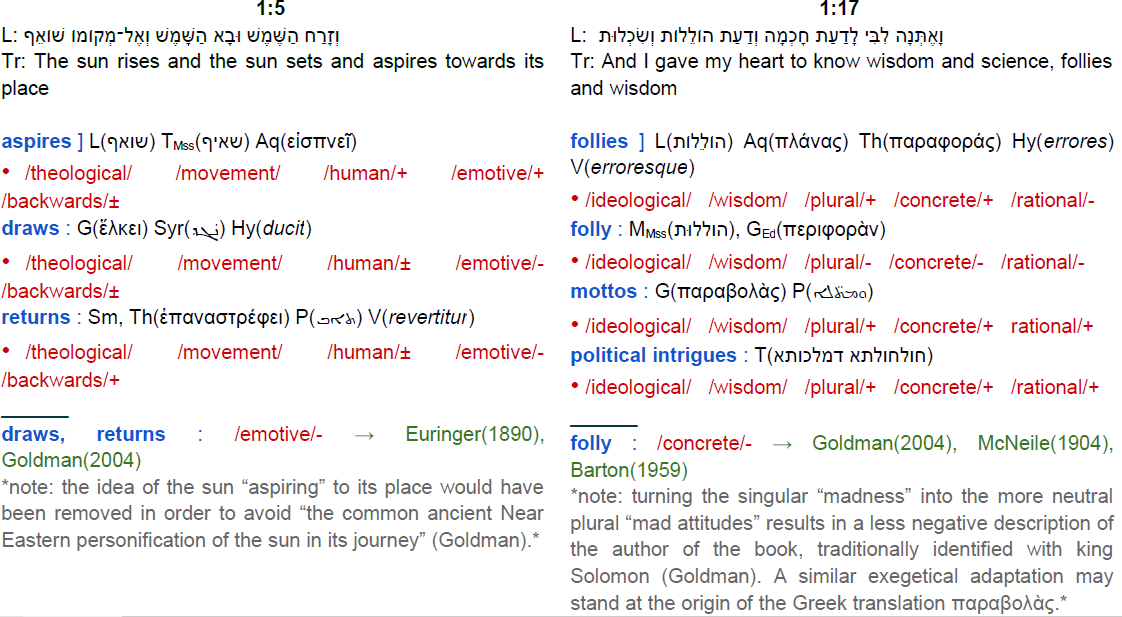
Two examples taken from Qohelet could clarify how componential analysis works. We chose them as they are relevant from the point of view of the theology (Qoh. 1:5) and the ideology (Qoh. 1:17) of the biblical book. The annotation is carried out through a Domain-Specific Language, as described in Bambaci and Boschetti (2020).
As can be seen, the variants have been aligned taking the lemma witnessed by “L” (the Codex Leningradensis)2 as point of departure. Each group of readings is accompanied, after the sigla of the witnesses and relative readings, by the semic analysis (preceded by “•”), which encompasses: 1. the specification of the domain (/theological/ for 1:5 and /ideological/ for 1:17); 2. the taxemes (/movement/ and /wisdom/); 3. the list of sememes (/human/, /plural/ etc.), in which each seme is a trait which can be present (“+”), absent (“-”) or indifferent (“±”). After the list of sememes (divided by six underscores), we find the justification, which links the variant to the item of the secondary literature — Euringer(1890), Goldman(2004) etc. — in which that particular interpretation is found. At the end, a short textual note (surrounded by asterisks) sums up the interpretation.
The definition of domains is taken from the field of biblical philology (Goldman 2004; Barthèlemy 2015): theological variants are those concerning religion and doctrinal issues, while ideological variants are those due, for example, to moral concerns. Unlike domains, taxemes and sememes are created by the annotator and constantly revised during the annotation process. The semantic features are by no means “intrinsic” to words nor their selection pretends to be “objective”: it is up to the annotator to choose the most appropriate features, according to the nature of the variants and to the secondary literature in which these are interpreted and discussed. In this respect, the justification is essential for it makes the criteria standing behind the alignment explicit and enables to link them to the secondary literature, thus allowing intersubjective verification.
After a final revision, all the relevant lexico-semantic relations between the semes are established within an ontology, which enables information retrieval based not only on the presence of the tag itself (e.g. /rational/), but also on semantically related tags, such as its antonym (/irrational/).
4. Discussion
In the present section we are going to discuss what we believe are the potentialities of componential analysis for the philologist engaged in aligning variant readings and evaluating the textual evidence for the purpose of reconstructing the critical text (restitutio textus).
Comparing readings is one of the basic tasks for a philologist (Cerquiglini 1999). When it is possible, variants are compared on the base of their graphic similarity (signifier); when it is not, such as in the case of multilingual traditions, they are aligned according to other criteria, which go from the presence of shared morphological traits (e.g. singular vs plural) to a presumptive similarity in meaning (signified). While the classification through the signifier is rather straightforward — and indeed it can be automated, for example by means of collation softwares — the alignment of readings according to other factors is far more complex and requires justifications, for it implies a higher level of abstraction and a certain degree of subjectivity. The criteria involved in textual decisions of this kind are generally discussed in critical commentaries, whose non-structured language prevents any operation of automated processing.
The strength of componential analysis lies precisely in that it enables to make these criteria explicit, for both the reader — hence allowing intersubjective control — and the machine — thus enabling for semantic-based queries. This last point is particularly important since it allows for new research modalities in textual criticism. Indeed, collation softwares and text-critical tools such as digital concordances (i.e. keywords in context) and repertories of variants are strongly “signifier-centered”: a user interested in studying a particular phenomenon of textual variation and its possible exegetical implications is heavily constrained by the classification of the readings in such devices, based on their graphemic form. The philologist will be able to retrieve all the variants expressed by the lemmas of the readings, but will never be put in the condition to get a general overview of other loci paralleli in which similar exegetical or ideological tendencies are at stake, independently of the “words” of the readings — their signifier — which express them. Componential analysis, on the other hand, would permit exploring variant corpora more in depth, in search for possible patterns and related textual phenomena.
5. Conclusion and perspectives
The kind of research described above could be relevant for textual criticism, since it permits to study the usus scribendi of an author or the attitudes of a copyist or translator, which is crucial for evaluating the textual evidence.
The method we have illustrated may represent a viable strategy for both performing the alignment and modeling the interpretatio through the data gathered from the secondary literature, thus combining ecdotics and hermeneutics in a unique frame.
So far, the first three out of twelve chapters of Qohelet have been collated and a total of 22 variants have been examined through componential analysis. The study is just a prototype: the analysis has focused on significant variants only, but it might be extended to all the variants of Qohelet. The analysis, moreover, has been carried out manually, by selecting the most relevant interpretations formulated by scholars in articles and monographies. In the future, some aspects of componential analysis may be automated, for example the alignment of morphological traits by means of part-of-speech tagging.